
Simplified VAT Reporting Across EU Countries
Published March 2026 | By Myriad Finance
If you’re a US company selling to Europe, understanding EU VAT compliance for non-EU businesses is critical. Whether you sell digital products, SaaS, or e-commerce goods, VAT regulations in the European Union can quickly become complex.
The solution? The One Stop Shop (OSS) VAT system — a simplified way to manage EU VAT registration, reporting, and payments across all EU member states.The OSS allows non-EU businesses to handle all their EU VAT obligations through a single registration in one member state. For US companies generating millions in EU revenue, this isn’t just convenient—it’s essential for sustainable growth.
This guide explains everything you need to know about OSS VAT for US companies, including registration, compliance, and strategies to scale your EU business.
What is OSS VAT? (One Stop Shop Explained)
The Simple Explanation
The One Stop Shop is the EU’s answer to cross-border VAT complexity. Instead of requiring businesses to register for VAT in each of the 27 EU member states where they sell, the OSS lets you:
- Register once in a single EU member state
- Report all EU sales through one quarterly VAT return
- Pay all VAT owed in one place, one currency (EUR)
- Receive automatic distribution of VAT to the correct member states
This makes OSS one of the most efficient solutions for EU VAT compliance for e-commerce and SaaS companies.
Why OSS VAT is Important for US Companies Selling in Europe
Before OSS, a US company selling to customers in Germany, France, Spain, and Italy needed separate VAT registrations in each country.
This meant:
- Four different registration processes
- Four sets of filing deadlines
- Four different languages and forms
- Four separate payments in different currencies
- Compliance with four different audit procedures
The administrative burden was crushing smaller businesses and deterring cross-border trade. The OSS system launched in 2021 to eliminate these barriers.
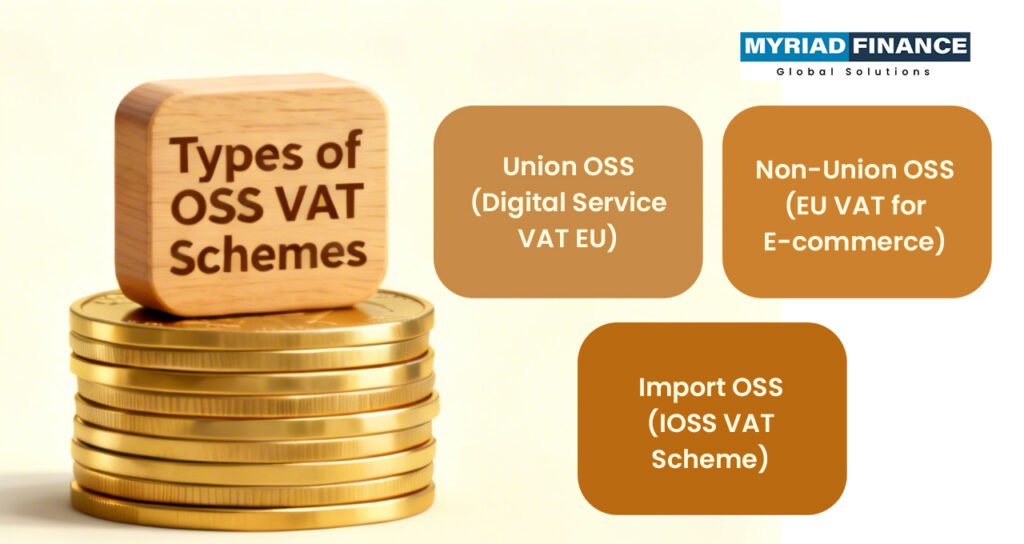
Types of OSS VAT Schemes: Which One Applies to Your Business?
1. Union OSS (Digital Service VAT EU)
Suitable for: Non-EU businesses providing B2C services or digital products to EU customers
Like:
- Software as a Service (SaaS) platforms
- Digital downloads (apps, music, e-books)
- Online courses and training
- Cloud storage and hosting services
- Streaming services
Key requirement: Services must be subject to VAT in the customer’s member state
2. Non-Union OSS (EU VAT for E-commerce)
Suitable for: Non-EU businesses selling physical goods directly to EU consumers
Like:
- E-commerce sellers shipping from EU warehouses
- Online retailers selling physical goods
- Subscription box businesses
Key requirement: Goods must be located in the EU at the time of sale (includes goods in EU warehouses)
3. Import OSS (IOSS VAT Scheme)
Suitable for: Non-EU businesses selling goods valued under €150 to EU consumers
Like:
- Low-value goods shipped to EU
Benefit: Here VAT is collected at the point of sale rather than at import, eliminating customs delays and additional fees for customers
How to Register for OSS VAT (Step-by-Step Guide)
Phase 1: Determine Eligibility (Week 1)
- Review Sales Volume: Review where your EU customers are located and what you’re selling
- Check Thresholds: Verify you meet the €10,000 annual threshold for distance selling
- Choose OSS Type: Union, Non-Union, or Import OSS based on your business model
- Select Member State: Choose where to register (often based on language preference or existing business connections)
Phase 2: Registration Setup (Weeks 2-3)
- Gather Documentation: Business registration, Tax ID, Bank details, Authorized representatives
- Complete Application: Submit online application through chosen member state’s tax authority
- Await OSS Number: Receive your unique OSS identification number
- Update Systems: Configure your invoicing and accounting systems for OSS compliance
Phase 3: Ongoing Compliance (Quarterly)
- Collect Transaction Data: Track all EU sales by member state and applicable VAT rate
- Prepare OSS Return: Submit quarterly return by the last day of the month following the quarter
- Make Payment: Pay total VAT owed in EUR to your registration member state (Single payment for all EU countries)
- Maintain Records: Keep detailed records for potential audits
Common OSS Compliance Challenges (And How to Avoid Them)
1. Incorrect VAT Rate Application
The Problem: Different EU countries have different VAT rates for the same product or service.
The Solution:
- Maintain updated VAT rate tables for all 27 EU member states
- Use automated systems that apply rates based on customer location
- Regular rate updates as countries change their VAT rates
2 . Customer Location Verification
The Problem: OSS requires accurate customer location data for proper VAT rate application.
The Solution:
- Implement robust customer verification processes
- Use IP address geolocation combined with billing address verification
- Maintain audit trails of location determination methods
3. Currency Conversion Issues
The Problem: Exchange rate fluctuations can affect VAT calculations and reporting.
The Solution:
- Use European Central Bank exchange rates for consistency
- Apply rates on the date of supply or payment
- Document your exchange rate methodology
4. Record Keeping Requirements
The Problem: Each EU member state has specific record keeping requirements.
The Solution:
- Maintain records for 10 years (the longest requirement among member states)
- Keep detailed transaction logs including customer location evidence
- Store records in formats acceptable to all member states
Advanced OSS Strategies for Scaling US Businesses
Multi-OSS Startegy
For businesses with complex operations, using multiple OSS registrations can optimize compliance:
- Union OSS: For digital services and B2C sales
- Non-Union OSS: For physical goods shipped from EU warehouses
- IOSS: For low-value goods shipped from the US
Technology Integration
Successful OSS implementation requires robust technology integration:
- ERP Integration: Automatic data flow from sales systems to OSS reporting
- Real-Time VAT Calculation: Dynamic VAT rate application at checkout
- Currency Management: Automated EUR conversion and reporting
- Audit Trail Maintenance: Comprehensive transaction logging
Compliance Optimization
- Quarterly Planning: Prepare OSS returns throughout the quarter, not just at filing time
- Cross-Border Validation: Regular reconciliation between OSS filings and individual country expectations
- Professional Support: Partner with specialists who understand both US business practices and EU compliance requirements
When OSS May Not work for Your Business
While OSS simplifies VAT compliance for most US businesses, there are exceptions:
B2B Sales Exemptions
- If you primarily sell to VAT-registered EU businesses, you may not need OSS
- B2B services are generally subject to reverse charge procedures
- However, mixed B2B/B2C businesses often benefit from OSS for the consumer portion
Concentrated in one EU Company
- If 90%+ of your EU revenue comes from one member state, direct registration might be simpler
- OSS adds complexity when you’re dealing primarily with one tax authority
Complex Product Mix
- Businesses with products subject to different VAT treatments across member states
- May require hybrid approaches combining OSS and direct registration
The Future of EU VAT Compliance
Upcoming Changes to Monitor
The EU continues to evolve its VAT systems. Key developments affecting US businesses:
- VAT in the Digital Age (ViDA): Proposed changes to real-time reporting requirements
- E-invoicing Mandates: Increasing requirements for electronic invoice formats
- Digital Services Expansion: Broader definition of services subject to destination-based VAT
Preparing for Evolution
- Build flexible systems that can adapt to changing requirements
- Partner with compliance providers who monitor regulatory changes
- Maintain detailed records that exceed current minimum requirements
Simplify Your EU VAT Compliance Today
The One Stop Shop system has fundamentally changed EU VAT compliance for US businesses.
At Myriad Finance Global Solutions, we help businesses
- Register for OSS VAT
- Manage EU VAT compliance
- Reduce compliance costs
- Scale globally with confidence
We’ve helped hundreds of US companies implement OSS strategies, typically reducing their EU VAT compliance costs by 60-75% while improving accuracy and reducing audit risk.
The key to successful OSS implementation is understanding your specific business model, choosing the right OSS type, and building robust systems for ongoing compliance. Whether you’re processing €50,000 or €50 million in annual EU sales, the principles remain consistent: simplify where possible, maintain accuracy, and focus on scalable processes.
Ready to Simplify Your EU VAT Compliance?
Don’t let complex VAT requirements limit your European growth potential. The OSS system can transform your compliance operations from a multi-country headache into a streamlined, single-country process.
Book A Call with our OSS specialists at Myriad Finance to discuss your specific situation and explore how the One Stop Shop can simplify your EU VAT reporting.
We will help you to:
- Analyze your current EU sales patterns and compliance obligations
- Determine the optimal OSS strategy for your business model
- Design a step-by-step implementation plan
- Show you exactly how to achieve 60-75% compliance cost reductions
- Answer all your questions about OSS registration and ongoing requirements
Visit us at myriadfin.com to learn more about our comprehensive EU VAT compliance and One Stop Shop services.