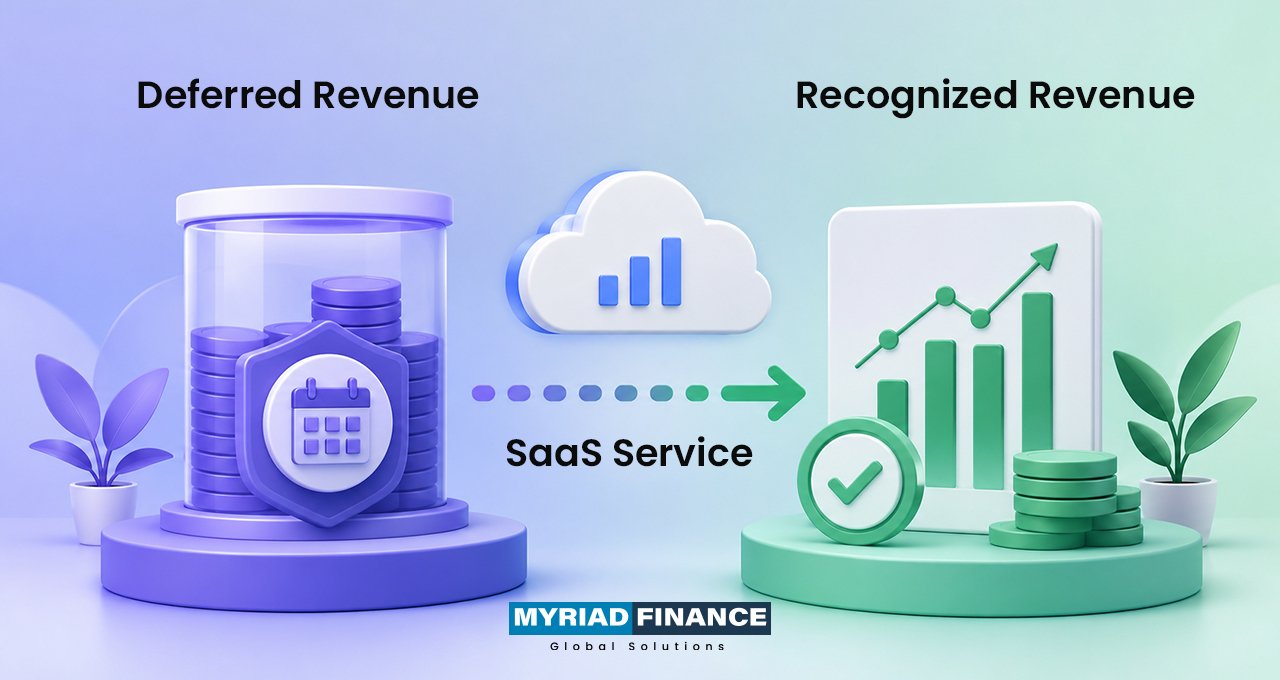

For SaaS founders, revenue is more than just a sales number. It affects financial reporting, cash flow planning, investor confidence, tax readiness, and overall business valuation. Two of the most important revenue concepts every SaaS business must understand are deferred revenue and recognized revenue.
Although both relate to customer payments, they are treated very differently in accounting. Understanding this difference is essential for accurate financial statements and better decision-making.
What Is Deferred Revenue?
Deferred revenue, also known as unearned revenue, is money received from customers before the service has been fully delivered.
This is common in SaaS businesses because customers often pay in advance for monthly, annual, or multi-year subscriptions. Even though the cash is received upfront, the revenue cannot be fully recorded immediately.
For example, if a customer pays $12,000 for a one-year SaaS subscription, the company receives the full cash amount at the beginning. However, the business has not yet delivered the full year of service. Therefore, the $12,000 is initially recorded as deferred revenue and recognized gradually over 12 months.
In this case, the company would recognize $1,000 per month as revenue.
Deferred revenue appears as a liability on the balance sheet because the company still has a future obligation to provide services to the customer.
What Is Recognized Revenue?
Recognized revenue is the portion of revenue that has actually been earned by delivering the product or service.
In SaaS, revenue is typically recognized over the subscription period because the customer receives access to the software over time. This means revenue recognition should match the period in which the service is provided.
Using the same example, although the company collected $12,000 upfront, only $1,000 would be recognized each month. This recognized revenue appears on the income statement and reflects the company’s actual performance for that period.
Deferred Revenue vs Recognized Revenue
The key difference is timing.
Deferred revenue represents cash received but not yet earned. It sits on the balance sheet as a liability.
Recognized revenue represents revenue that has been earned. It appears on the income statement as income.
This distinction is especially important for SaaS companies because subscription businesses often receive cash before services are fully delivered. Without proper accounting, revenue can be overstated, profitability can look misleading, and financial reports may not reflect the true health of the business.
Why This Matters for SaaS Founders
Accurate revenue recognition helps SaaS founders understand the real performance of their business. It also plays a major role in investor reporting, compliance, and financial planning.
For U.S.-based SaaS companies, revenue recognition is often guided by ASC 606, which requires companies to recognize revenue when performance obligations are satisfied, not simply when cash is collected.
Proper revenue tracking helps founders:
- Present accurate financial statements
- Avoid overstating income
- Track future revenue obligations
- Improve cash flow forecasting
- Prepare for investor due diligence
- Monitor MRR, ARR, churn, and growth trends
- Make better budgeting and hiring decisions
For early-stage and scaling SaaS companies, clean revenue reporting can also improve credibility with investors, lenders, and potential acquirers.
Common SaaS Revenue Recognition Challenges
As SaaS companies grow, revenue recognition can become more complex. Founders may need to account for annual plans, multi-year contracts, usage-based pricing, discounts, upgrades, downgrades, cancellations, refunds, onboarding fees, and bundled services.
Each of these items can affect how and when revenue should be recognized.
For example, if a SaaS company charges separately for implementation, support, and software access, each component may need to be reviewed carefully to determine the correct accounting treatment.
This is why SaaS accounting requires more than basic bookkeeping. It needs a structured process, accurate revenue schedules, and a clear understanding of subscription-based financial reporting.

How Myraid Finance Can Help
At Myraid Finance, we specialize in outsourced accounting for SaaS and eCommerce businesses serving the U.S. market. Our team understands the accounting challenges faced by subscription-based businesses and helps founders build reliable, compliant, and scalable finance processes.
Our SaaS accounting support includes:
- Deferred revenue tracking
- Revenue recognition support
- ASC 606-aligned accounting processes
- Monthly bookkeeping and reconciliations
- MRR and ARR reporting
- Subscription billing reconciliation
- Cash flow forecasting
- Management reporting
- Investor-ready financial statements
- Support for fundraising and due diligence preparation
We help SaaS founders move beyond basic bookkeeping by providing accurate financial insights that support better decisions and long-term growth.
Final Thoughts
Deferred revenue and recognized revenue are essential concepts for every SaaS founder. While upfront payments can strengthen cash flow, they do not always represent earned revenue.
By properly tracking deferred and recognized revenue, SaaS businesses can maintain accurate financial statements, stay compliant, improve forecasting, and build trust with investors.
Ready to Strengthen Your SaaS Accounting?
If your SaaS business needs accurate revenue recognition, deferred revenue tracking, or investor-ready financial reporting, Myraid Finance can help.
Our experts provide outsourced accounting solutions designed specifically for SaaS and eCommerce businesses in the U.S.