How Ecommerce Businesses Can Keep Their Books, Taxes, and Cash Flow Under Control?
Selling on Amazon or Shopify can be remarkably simple to start.
Managing the finances of a growing ecommerce business is a different story.
As sales increase, ecommerce businesses often find themselves dealing with multiple sales channels, payment processors, refunds, chargebacks, marketplace fees, inventory purchases, sales tax, advertising expenses, shipping costs, and international transactions.
The result is a common problem: revenue is growing, but the financial picture isn’t always clear.
This is where specialized Amazon and Shopify accounting becomes important.
At Myriad Fin, we help ecommerce businesses organize their books, reconcile their sales channels, understand their profitability, and build reliable financial systems that support growth.
Why Ecommerce Accounting Is Different
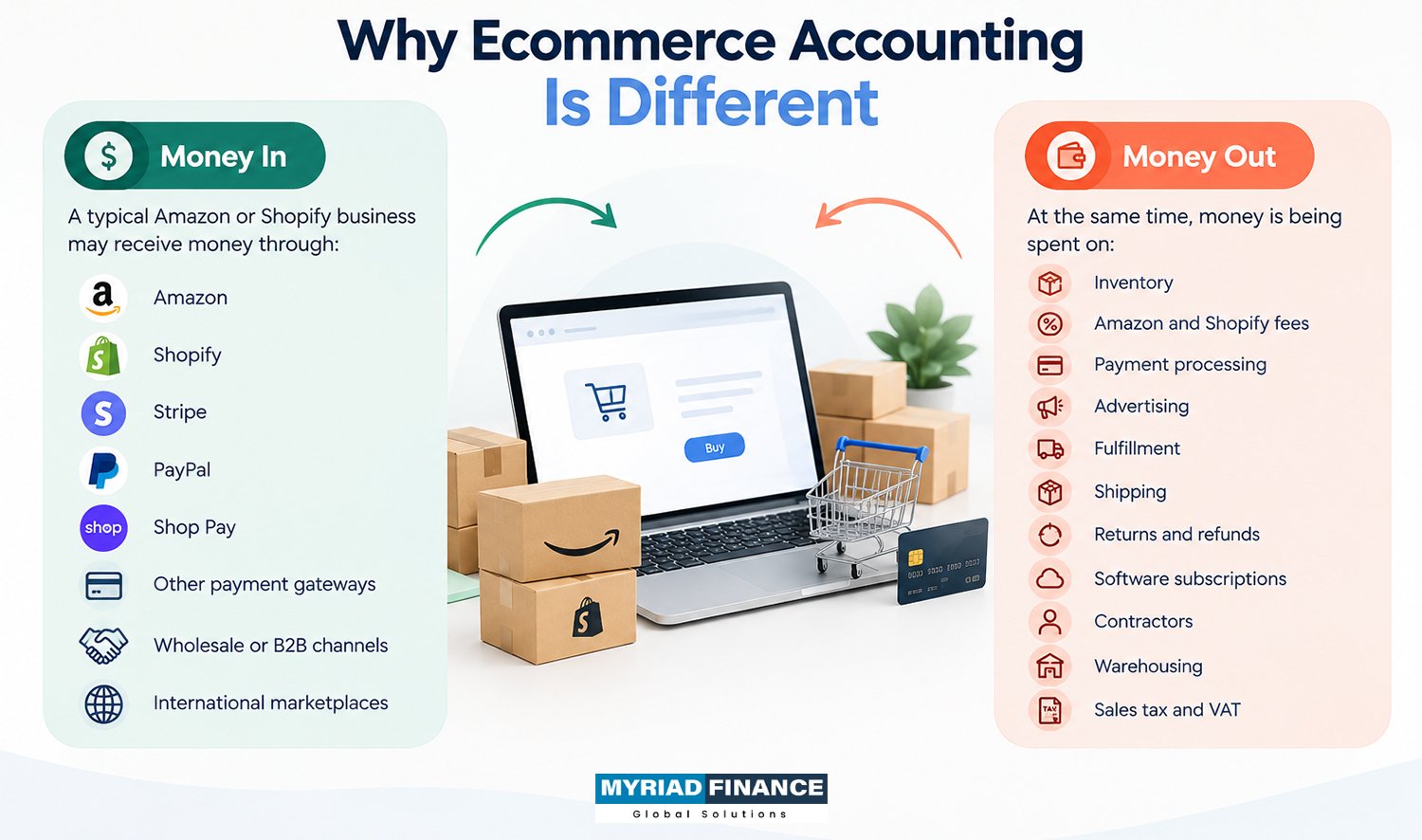
Traditional bookkeeping often assumes that a customer pays a business directly and the transaction appears straightforward in the bank account.
Ecommerce doesn’t work that way.
A typical Amazon or Shopify business may receive money through:
- Amazon
- Shopify
- Stripe
- PayPal
- Shop Pay
- Other payment gateways
- Wholesale or B2B channels
- International marketplaces
At the same time, money is being spent on:
- Inventory
- Amazon and Shopify fees
- Payment processing
- Advertising
- Fulfillment
- Shipping
- Returns and refunds
- Software subscriptions
- Contractors
- Warehousing
- Sales tax and VAT
Simply recording deposits into a bank account does not provide an accurate picture of the business.
The accounting needs to capture what happened between the sale and the money reaching the bank.
Amazon Bookkeeping: Why Marketplace Reconciliation Matters
Amazon sellers frequently look at their bank deposits and assume those deposits represent their sales.
They don’t.
An Amazon settlement can include sales, refunds, marketplace fees, advertising charges, fulfillment costs, adjustments and other deductions.
For example, a business might generate $100,000 in Amazon sales but receive considerably less in its bank account because Amazon has already deducted various fees and expenses.
If bookkeeping only records the final deposit, the financial statements can significantly understate both revenue and expenses.
Proper Amazon bookkeeping should therefore include marketplace reconciliation.
This means matching Amazon settlement information with the accounting records and ensuring that sales, fees, refunds and other transactions are correctly classified.
The objective is simple:
Your accounting records should explain exactly where the money came from and where it went.
Shopify Accounting: More Than Recording Online Sales
Shopify gives merchants an excellent platform for selling online, but the accounting behind a Shopify store can become increasingly complex as the business grows.
A Shopify merchant may have transactions flowing through Shopify Payments, PayPal, Stripe, Shop Pay and other gateways.
There may also be:
- Discounts
- Refunds
- Gift cards
- Shipping income
- Sales taxes
- Transaction fees
- Payment processing fees
- Multiple currencies
- Multiple Shopify stores
This makes Shopify bookkeeping and payment reconciliation particularly important.
Instead of simply recording the amount deposited into the bank, ecommerce accounting should reconcile the underlying Shopify transactions with payment processor settlements and the general ledger.
This gives business owners a much clearer understanding of actual sales and profitability.
Revenue Is Not the Same as Profit
One of the biggest mistakes ecommerce businesses make is focusing primarily on revenue.
A store generating $1 million in annual sales isn’t necessarily more profitable than a store generating $500,000.
The real questions are:
- What is the gross margin?
- How much is being spent on advertising?
- What are Amazon or Shopify fees?
- What does fulfillment cost?
- How much inventory is sitting in the warehouse?
- How much cash is tied up in inventory?
- What is the true contribution margin?
- How much cash is the business actually generating?
This is why ecommerce accounting needs to go beyond basic bookkeeping.
Accurate financial reporting should help the owner understand the economics of the business.
Inventory Can Hide Your Cash
Inventory is another major accounting challenge for ecommerce businesses.
A growing business may look profitable on its income statement while simultaneously experiencing cash-flow pressure.
Why?
Because cash has been used to purchase inventory that has not yet been sold.
For example:
$500,000 in sales does not mean $500,000 is available to spend.
Some of that money may be required to:
- Reorder inventory
- Pay suppliers
- Cover freight
- Fund advertising
- Pay marketplace fees
- Cover payroll and operating expenses
Good ecommerce accounting connects the income statement with inventory and cash flow.
That gives business owners a better understanding of how much cash is actually available for growth.
Sales Tax Becomes More Important as You Grow
Sales tax can become increasingly complicated as an ecommerce business expands across the United States.
Depending on where customers are located, where the business operates, marketplace relationships, economic nexus thresholds and other factors, sales-tax obligations can vary.
Amazon and other marketplaces may collect and remit certain taxes on behalf of sellers in specific circumstances.
That does not necessarily mean the seller can ignore sales-tax compliance altogether.
A growing ecommerce business should understand:
- Where it may have sales-tax obligations
- Which marketplaces are collecting tax
- Which transactions require attention
- Whether registrations are necessary
- How sales-tax information should be reflected in the accounting system
Accounting and tax compliance should therefore be considered part of the ecommerce infrastructure, rather than something addressed only at year-end.
Don’t Wait Until Tax Season to Understand Your Numbers
One of the most expensive accounting mistakes an ecommerce business can make is treating bookkeeping as a year-end exercise.
By the time the books are finalized, several months may have passed.
The business owner may then discover that:
- Margins have declined
- Advertising costs have increased
- Inventory has grown too quickly
- A product is selling well but generating little profit
- Cash flow is tightening
- Expenses have been incorrectly categorized
Monthly bookkeeping and financial reporting allow these issues to be identified much earlier.
Instead of asking:
“How did we do last year?”
the business owner can ask:
“What’s happening in the business right now?”
When Should an Amazon or Shopify Business Consider Outsourced Accounting?
Outsourced ecommerce accounting can make sense when the business owner is spending too much time dealing with financial administration or when the existing bookkeeping process is no longer keeping pace with growth.
Some common warning signs include:
- Multiple sales channels – The business is selling through Amazon, Shopify and other platforms, making reconciliation increasingly difficult.
- Increasing transaction volume – Hundreds or thousands of monthly transactions make manual bookkeeping inefficient and error-prone.
- Growing inventory – Inventory purchases, landed costs and stock levels are becoming significant components of the business.
- International sales – The business is dealing with multiple currencies, international customers, VAT or other tax requirements.
- Unclear profitability – Revenue is increasing, but the owner cannot confidently answer how much the business actually makes.
- The owner is doing the bookkeeping – Time that should be spent on products, customers, marketing and growth is being consumed by accounting administration.
What a Good Ecommerce Accounting System Should Provide
A strong accounting setup should give an ecommerce business a reliable financial foundation.
At a minimum, it should provide:
Accurate bookkeeping
Transactions are properly categorized and recorded.
Marketplace reconciliation
Amazon, Shopify and other sales channels are reconciled with the accounting records.
Payment processor reconciliation
Stripe, PayPal and other payment platforms are properly accounted for.
Monthly financial statements
The owner can review the business regularly rather than waiting until year-end.
Inventory visibility
Inventory purchases and stock-related cash requirements are reflected properly.
Cash-flow visibility
The business can understand where cash is coming from and where it is going.
Tax-ready records
Financial records are organized to support tax preparation and compliance.
Management insight
Financial reporting helps identify trends, margins, expenses and opportunities.
Integrating Ecommerce Platforms With Accounting Software
Modern ecommerce businesses don’t necessarily need to manage every transaction manually.
Accounting systems such as QuickBooks Online and Xero can be connected with ecommerce platforms and payment processors using appropriate integrations and reconciliation tools.
For Amazon sellers, tools such as A2X can help bring marketplace transaction data into accounting systems in a structured manner.
The technology, however, is only part of the solution.
An integration can move data.
It cannot decide whether the accounting treatment is correct, whether an account is properly mapped, or whether the resulting financial statements actually make sense.
That’s where experienced ecommerce bookkeeping and accounting support becomes valuable.
Bookkeeping vs. Virtual CFO Services for Ecommerce Businesses
Not every ecommerce business needs a CFO immediately.
But many growing businesses eventually need more than bookkeeping.
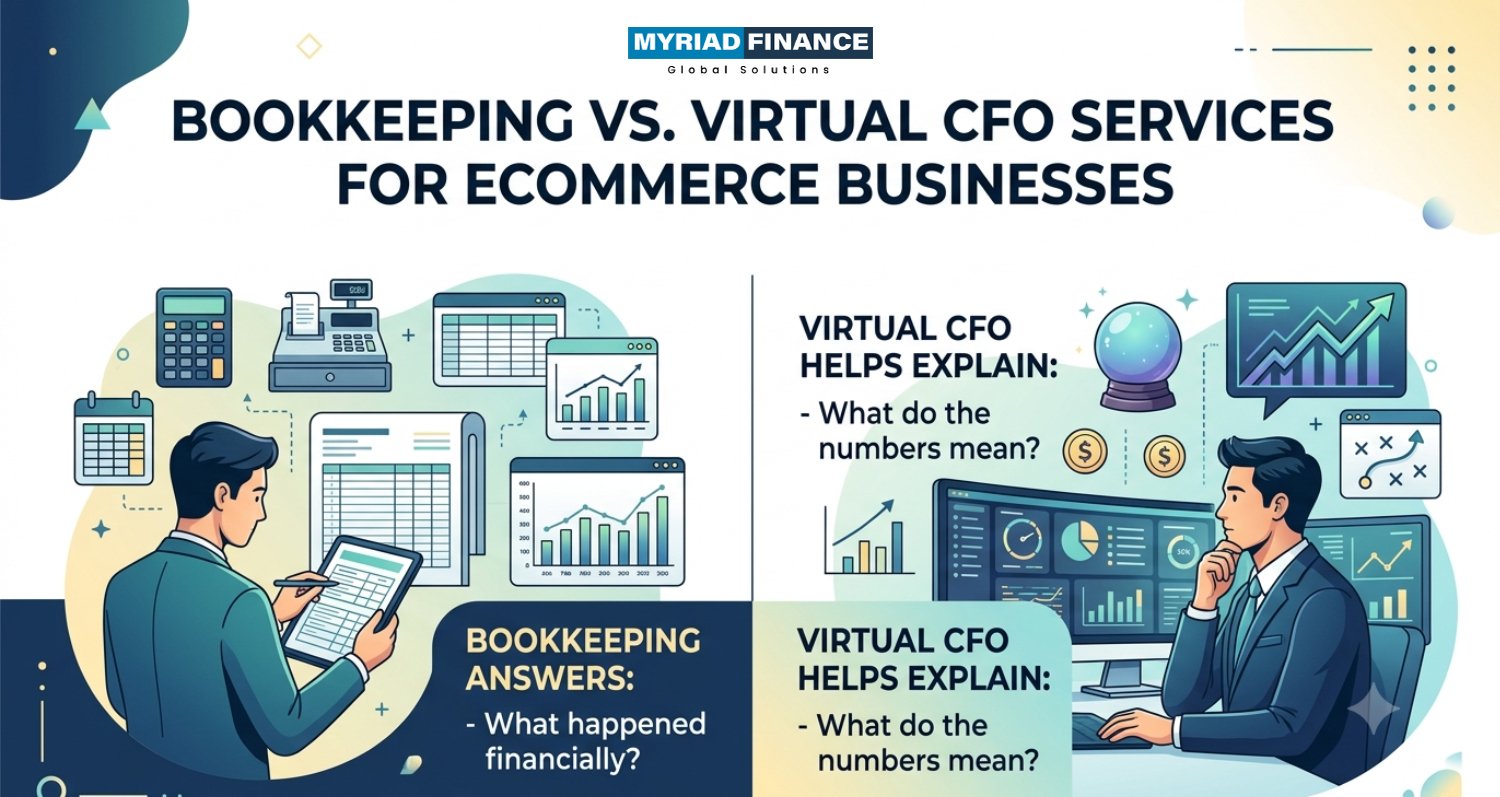
Bookkeeping answers:
What happened financially?
Accounting helps explain:
What do the numbers mean?
Virtual CFO support helps answer:
What should we do next?
For a growing Amazon or Shopify business, CFO-level support can include:
- Cash-flow planning
- Budgeting
- Financial forecasting
- Profitability analysis
- Scenario planning
- Inventory planning
- KPI reporting
- Business performance analysis
- Strategic financial decision-making
This becomes particularly useful when an ecommerce business is moving from simply generating sales to building a scalable, profitable company.
A Better Financial Foundation for Ecommerce Growth
Amazon and Shopify have made it easier than ever to build an ecommerce business.
But as the business grows, the financial complexity grows with it.
More sales can mean more transactions.
More products can mean more inventory.
More customers can mean more refunds and chargebacks.
More markets can mean more tax and compliance requirements.
And more revenue does not automatically mean more profit.
That is why ecommerce businesses need accounting systems designed around the way ecommerce actually works.
At Myriad Fin, we provide bookkeeping, ecommerce accounting, virtual CFO and tax-compliance support designed to help growing businesses get a clearer view of their financial performance.
Whether you sell primarily through Amazon, Shopify or multiple ecommerce channels, the goal is the same:
Know your numbers. Understand your profitability. Control your cash flow. Make better decisions.
Ready to Get Your Ecommerce Finances Under Control?
If you’re an Amazon or Shopify seller and your bookkeeping is becoming difficult to manage, Myriad Fin can help you build a more reliable accounting and financial reporting system.
From day-to-day bookkeeping and marketplace reconciliation to financial reporting, cash-flow planning and virtual CFO support, we help ecommerce businesses turn financial data into information they can actually use.
Your ecommerce business is growing. Your accounting system should grow with it.
Frequently Asked Questions
- What is Amazon accounting?
Amazon accounting is the process of recording, categorizing and reconciling Amazon sales, fees, refunds, settlements and related business transactions within an accounting system. - What is Shopify accounting?
Shopify accounting involves properly recording Shopify sales, payment transactions, refunds, discounts, taxes, processing fees and other ecommerce transactions in the business’s accounting records. - Why do Amazon sellers need bookkeeping?
Amazon sellers need accurate bookkeeping to understand revenue, marketplace fees, expenses, inventory, profitability and cash flow, while maintaining organized financial records for tax and business purposes. - Can Myriad Fin handle Shopify bookkeeping?
Yes. Myriad Fin provides ecommerce bookkeeping and accounting support for businesses selling through Shopify and other ecommerce channels. - Can ecommerce businesses outsource their bookkeeping?
Yes. Outsourcing bookkeeping can allow ecommerce owners to spend less time on financial administration while gaining access to experienced bookkeeping and accounting support. - When should an ecommerce business consider a virtual CFO?
A virtual CFO can become valuable when an ecommerce business needs better cash-flow forecasting, budgeting, profitability analysis, financial planning and strategic decision support as it grows.