

Why landed cost is becoming one of the most important numbers for ecommerce sellers in 2026. You found a product.
Welcome to the world of landed cost.
What exactly is landed cost?
In simple terms, landed cost is what it actually costs to get your inventory from the supplier to the point where it is ready to sell.
It goes beyond the supplier’s invoice.
Depending on your product, country of origin and shipping model, landed cost can include:
- Product or supplier cost
- International freight
- Shipping and insurance
- Import duties
- Tariffs
- Customs brokerage
- Port and handling charges
- Inbound transportation
- Other costs directly associated with bringing inventory into your business
A simple way to think about it is:
Landed Cost = Product Cost + Freight + Duties + Tariffs + Customs & Other Inbound Costs
The exact calculation depends on the product, origin, destination, customs classification and shipping arrangement.
And this distinction matters.
Supplier price is not landed cost.
Here’s where ecommerce sellers get into trouble
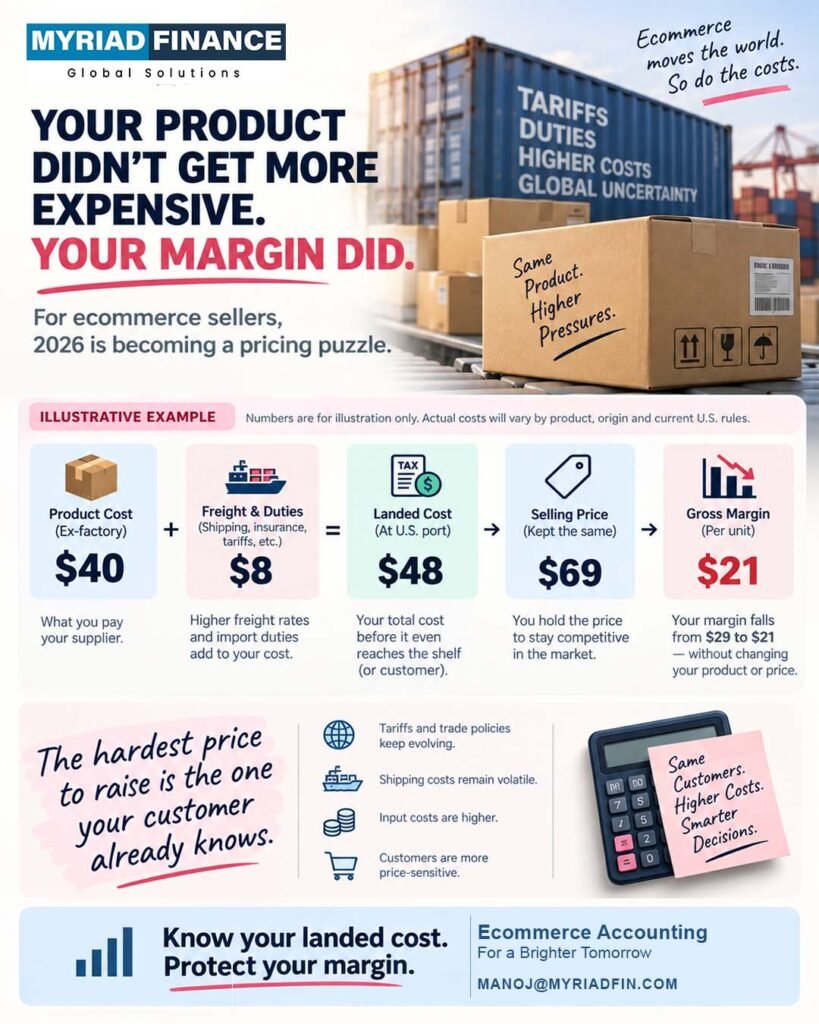
Let’s take a deliberately simple example.
You sell a product for: $69
Your supplier charges:$40
You look at that and think:$29 gross margin.
But suppose getting that product into your U.S. inventory adds another $8 per unit in freight, duties, insurance and related inbound costs.
Your actual landed cost is now: $48
Your gross margin has fallen to:$21
Nothing changed on your product page.
The customer still sees $69.
Your supplier still sees $40.
But your business sees a very different number.
That’s the problem.
The customer sees the selling price.
The supplier sees the purchase price.
The business needs to see the complete cost.
Why landed cost matters even more in 2026
For U.S. ecommerce businesses importing products, the cost environment has become more complicated.
U.S. import prices increased 0.7% in August 2026 and were 7.0% higher than a year earlier, according to Labor Department data reported by Reuters.
At the same time, U.S. retailers have been adjusting shipping and inventory strategies amid tariff and freight pressures. The Port of Los Angeles, for example, reported record three-month container volumes during June through August 2026 as retailers accelerated some imports ahead of anticipated tariff and shipping-cost changes.
For an ecommerce seller, all of this eventually comes back to one question:
What does this product actually cost me?
Not six months ago.
Not when the first purchase order was created.
Now.
The Amazon FBA problem
Amazon sellers have an additional layer of complexity.
Your product doesn’t simply go:
Supplier → Customer
It may go:
Supplier → Freight Forwarder → Customs → Port → Warehouse → Amazon FBA → Customer
And then you have the selling-side costs:
Amazon fees + FBA fees + advertising + refunds + returns + other operating costs
This is why Amazon FBA accounting needs to go beyond simply reconciling Amazon deposits with the bank account.
Your books should help you understand:
- What did each product actually cost?
- What did Amazon charge?
- How much did advertising consume?
- What was refunded?
- What inventory remains?
- What did each SKU actually contribute?
- Which products are making money?
- Which products are simply generating revenue?
Because there is a big difference between:
“We sold $500,000.”
and
“We generated $500,000 in revenue and know exactly what we kept.”
And Shopify sellers aren’t immune
Shopify gives a brand much more control over its storefront.
It doesn’t make the math disappear.
A Shopify business still needs to account for:
**Product cost
- landed cost
- payment processing
- fulfilment
- shipping
- advertising
- returns
- discounts
- sales tax obligations
- software and operating costs**
That is why good Shopify accounting isn’t simply about making sure transactions enter QuickBooks or Xero correctly.
It is about turning those transactions into information you can actually use.
Landed cost is not the same as profit
This distinction is important.
Landed cost tells you what it costs to get inventory to its selling-ready destination.
It does not automatically include everything that happens after that.
For example:
Product cost
- Freight & import costs
= Landed cost
Then:
Landed cost
- Marketplace / payment fees
- Fulfilment
- Advertising
- Returns
- Other selling costs
gets you much closer to understanding your true contribution margin.
That is why looking only at supplier price can produce a very flattering spreadsheet.
Spreadsheets, unfortunately, are excellent at being flattering.
Until the bank account disagrees.
The SKU that looks profitable may not be
Imagine you sell three products.
| Product | Selling Price | Landed Cost | Other Selling Costs | Approx. Contribution |
|---|---|---|---|---|
| Product A | $50 | $20 | $15 | $15 |
| Product B | $70 | $48 | $16 | $6 |
| Product C | $90 | $35 | $20 | $35 |
All three generate sales.
But they don’t generate the same economics.
Product B may be your best seller.
It may also be the product quietly consuming your margin.
This is why ecommerce profitability needs to be looked at at the product, channel and business level.
Revenue tells you what moved.
Unit economics tells you whether it was worth moving.
What should ecommerce sellers track?
At a minimum, a growing ecommerce business should have visibility into:
1. Product Cost
What are you actually paying your supplier?
2. Landed Cost
What does it cost to get that inventory ready to sell?
3. Selling Costs
What are Amazon, Shopify, payment processors and other platforms charging?
4. Customer Acquisition Cost
How much are you spending to generate the sale?
5. Returns and Refunds
How much revenue comes back out?
6. Inventory
How much cash is sitting inside unsold stock?
7. Contribution Margin
After the direct costs of making and selling the product, how much is actually left?
This is where ecommerce accounting becomes more than bookkeeping.
It becomes decision-making information.
The uncomfortable question
Here’s a useful exercise.
- Take your top-selling SKU.
- Don’t look at the selling price.
- Don’t look at the supplier invoice.
- Don’t look at the Amazon or Shopify dashboard alone.
Ask:
“If I sold one more unit today, what would that sale really contribute to my business?”
If you can answer that quickly, you’re probably looking at your business the right way.
If you need three spreadsheets, four dashboards and a calculator…
there may be some work to do.
What should an ecommerce business do about it?
You don’t necessarily need a complicated finance department.
You do need a reliable system.
Your accounting should bring together data from the places where your business actually happens:
- Amazon
- Shopify
- Payment processors
- Inventory systems
- Advertising platforms
- Bank accounts
- Expenses
Then that information needs to be reconciled, categorized and turned into useful financial reporting.
The goal isn’t to produce more reports.
The goal is to know what the reports are telling you.
Because if your landed cost changes but your pricing doesn’t…
your margin changes.
If your inventory grows faster than your sales…
your cash gets tied up.
If advertising costs rise…
your contribution margin falls.
And if none of this shows up clearly in your financial reporting…
you may discover the problem after the money has already left the bank.
The bottom line
Your product may still cost $40.
Your customer may still pay $69.
But what happens between those two numbers determines whether you have a healthy ecommerce business.
That’s why landed cost accounting, inventory accounting, Amazon FBA accounting and Shopify accounting matter.
Not because accounting needs more numbers.
Because your business needs the right numbers.
Know your landed cost.
Know your margin.
Know where your cash is going.
Because the most expensive number in ecommerce is sometimes the one you never calculated.
How Myriad Finance helps ecommerce businesses
Myriad Finance provides specialized ecommerce accounting services for growing online businesses, including businesses selling through Amazon, Shopify and other ecommerce platforms.
Our focus is not just on keeping the books clean.
It is on helping business owners get a clearer view of their revenue, expenses, inventory, cash flow, profitability and financial performance.
Because good accounting should help you understand the business you’re building, not just record the business you’ve already built.
Myriad Finance
Simplify. Streamline. Scale.