
If your business sells goods or services to customers in the European Union, VAT compliance is one of the first things you need to get right. For ecommerce brands, SaaS companies, and digital businesses, one question comes up again and again:
Do you need OSS registration, local VAT registration, or both?
The answer depends on what you sell, where your customers are, whether you hold stock in the EU, and how your transactions are structured. In this guide, we break down the key differences between OSS and local VAT registration, explain when each one applies, and show how Myriad Finance can help your business stay compliant.
What Is OSS Registration?
The One Stop Shop (OSS) is an EU VAT simplification system. It allows businesses to register once, file one return, and make one payment through a single EU Member State — all for certain cross-border sales to EU consumers.
According to official EU guidance, OSS reduces the need for multiple VAT registrations across Member States for covered transactions.
OSS can apply to:
- Certain cross-border B2C sales of goods within the EU
- B2C services taxable in an EU Member State
- Specific ecommerce transactions covered by the Union, non-Union, or Import OSS frameworks
However, OSS is a simplification tool — not a complete replacement for all local VAT obligations.
What Is Local VAT Registration?
Local VAT registration means registering directly in a specific EU country. It also means complying with that country’s individual VAT filing and reporting requirements.
You may still need a local VAT registration even if you already use OSS. This is especially true when you have taxable activities in a Member State that fall outside OSS coverage — such as domestic supplies, stock movements, or imports.
The European Commission confirms that multiple registrations can still be necessary when transactions fall outside the current OSS framework.
OSS vs Local VAT Registration: What Is the Difference?
Here is a simple way to understand the difference:
| OSS | Local VAT Registration | |
| Purpose | Reports eligible cross-border B2C transactions | Covers country-specific VAT obligations |
| Where you register | One EU Member State | Each relevant EU country separately |
| Best for | Cross-border B2C sales within scope | Domestic supplies, stock, imports |
| Replaces local registration? | Not always | Required when outside OSS scope |
So the real question is not which option is better. Instead, ask yourself: which of my transactions can go through OSS, and which still need local VAT registration?
For many businesses, the honest answer is both.
When OSS May Be Enough
OSS may be sufficient if your business makes eligible cross-border B2C sales and you have no separate local VAT obligations. This is the simplest scenario, and it is the one OSS was designed for.
OSS could be enough if you are:
- An EU-based business making intra-EU distance sales of goods to consumers in other Member States
- A business providing eligible B2C services to consumers across the EU
- A non-EU business using the non-Union OSS for covered B2C services supplied to non-taxable persons in the EU
It is also worth noting the EU-wide €10,000 threshold for certain intra-EU distance sales of goods and TBE services. Below this threshold, VAT may remain due in the Member State of establishment — but this rule does not apply in every situation. Therefore, apply it carefully based on your specific facts.
When Local VAT Registration May Still Be Required
Even if you use OSS, local VAT registration may still be needed in one or more EU countries. Here are the most common reasons why.
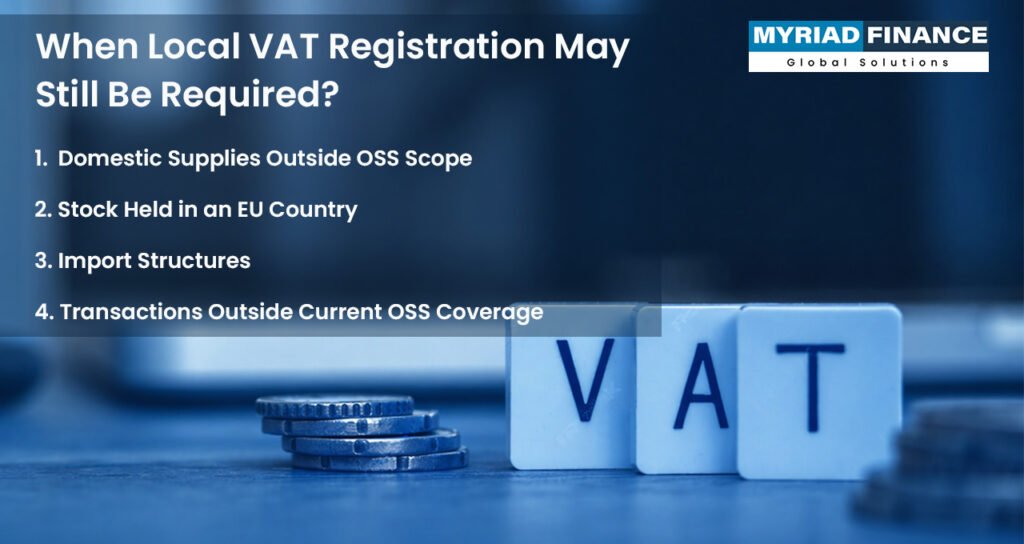
- Domestic Supplies Outside OSS Scope
Domestic supplies of goods are generally not covered by the Union OSS — except in limited deemed-supplier cases involving electronic interfaces. Therefore, if you make ordinary domestic supplies in a Member State, you may still need local registration there.
- Stock Held in an EU Country
Holding inventory in an EU country often brings local VAT obligations. This is particularly true when the structure involves domestic sales, stock transfers, or dispatches from that country. The precise VAT consequence depends on how goods actually move.
- Import Structures
If you import goods into the EU, the VAT treatment depends on your import model, the value of goods, and your supply chain setup.
For example, the Import One Stop Shop (IOSS) simplifies VAT for certain consignments not exceeding €150. However, other import structures may still trigger local VAT obligations.
- Transactions Outside Current OSS Coverage
Some transactions simply fall outside the current OSS framework. EU policy discussions around “single VAT registration” reforms confirm this. As a result, businesses in these situations still need multiple registrations.
Common Business Scenarios
Understanding how OSS and local VAT registration apply in practice is easier with real examples.
- Ecommerce seller shipping from one EU country to EU consumers: If the transactions qualify as intra-EU distance sales, OSS can centralize your VAT reporting for those sales.
- Ecommerce business using multiple warehouses or fulfilment networks: Where stock is held in several Member States, local VAT registrations may still be needed for domestic supplies and stock movements.
- Non-EU SaaS or digital services business selling to EU consumers: A non-EU supplier of B2C services may be able to use the non-Union OSS for covered services supplied to non-taxable persons in the EU.
- Business importing goods into the EU and selling locally: This often requires a separate local VAT analysis and may require local VAT registration, depending on the country and business structure.
Why Getting This Right Matters
Using the wrong VAT setup can lead to serious problems. These include unnecessary registrations, missed registrations, incorrect reporting, financial penalties, and operational disruption.
Because EU VAT treatment depends heavily on the actual flow of goods and services, avoid relying on general assumptions. For example, assuming “OSS covers everything” or “holding stock always leads to the same outcome in every country” can be costly mistakes. Official EU materials confirm that VAT rules are highly transaction-specific.
A Practical Rule to Remember
Here is a simple working rule to guide your thinking:
Use OSS for eligible transactions within its scope. Then separately review whether local VAT registration is needed for domestic supplies, stock-related activities, imports, or other country-specific obligations.
This is why two businesses that look commercially similar can end up with very different VAT registration requirements in Europe.
How Myriad Finance Can Help
At Myriad Finance, we specialize in EU VAT compliance for ecommerce brands, SaaS companies, and digital businesses. We help you understand your exact obligations — and then support you in meeting them.
Our team can assist with:
- Reviewing whether your business needs OSS, non-Union OSS, IOSS, local VAT registration, or a combination
- Assessing your transaction flows, inventory setup, and VAT touchpoints
- Supporting registrations and ongoing compliance filings
- Helping ecommerce and SaaS businesses reduce VAT risk as they grow across borders
Because VAT outcomes depend on the specific facts of your business, the most valuable first step is a practical review of your model — not just a generic checklist.
Final Thoughts
So, do you need OSS or local VAT registration in the EU?
For most businesses, it is not a simple either-or answer. OSS is extremely useful for eligible cross-border B2C supplies. However, local VAT registration may still be necessary when your activities fall outside the current OSS scope.
The right answer depends on your supply chain, customer base, stock locations, and transaction types.
If your business is growing into Europe, getting clarity on your VAT obligations early makes everything easier down the road.
Need Help With EU VAT Compliance?
Not sure whether your business needs OSS, local VAT registration, or both? Myriad Finance can help you review your current setup and build a practical VAT compliance strategy for EU growth.
👉 Get in touch with Myriad Finance today